

OUR ASSESSMENTScoring AI Readiness
Powerful AI products for talent and workforce are shipping constantly. Most organisations aren't ready for them.
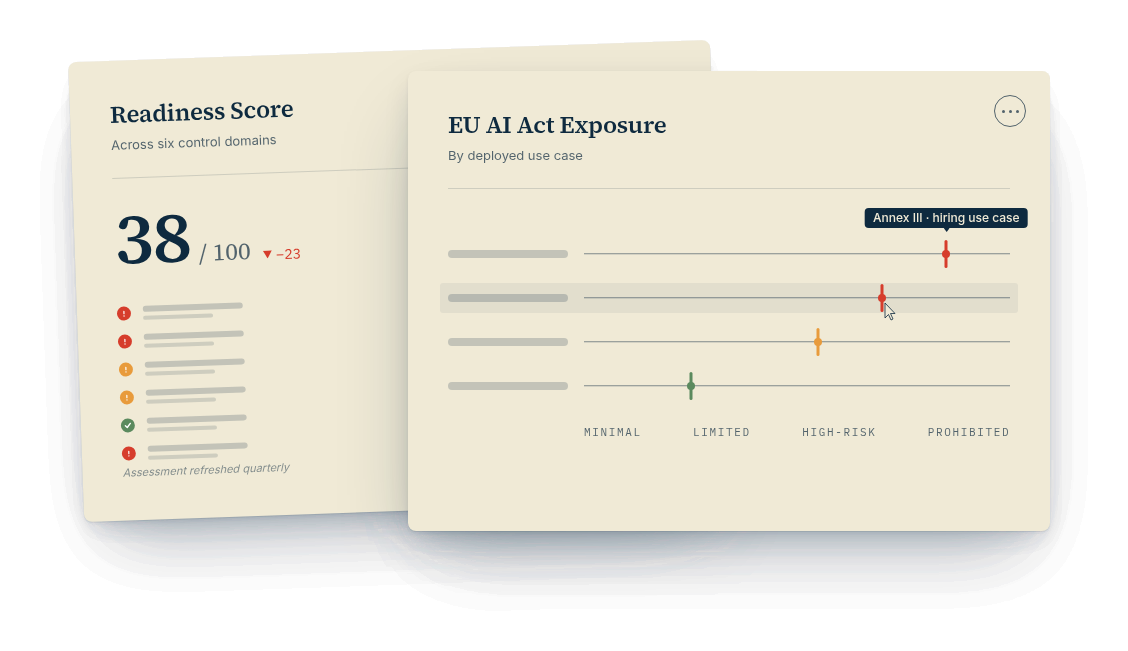
Our structured assessment pairs senior consultants with research agents to score readiness across data, context and governance, including EU AI Act exposure.
We build a dependency map and business case for closing the gaps in product performance. Delivered in 4-6 weeks.
OUR METHOD From UX to Risk Review

STAKEHOLDER VIEWS
Human and agentic interviews with the people closest to the product — structured, consistent across stakeholders, less calendar-heavy than a traditional consulting sweep.
TECHNICAL DISCOVERY
A gap analysis on in-scope AI features. What actually reaches the model before the reasoning layer kicks in.

SUPER-USER SESSIONS
Co-working with users and success teams to see how automated features land in practice — adoption, workarounds, and the decisions the AI doesn't yet get to make.
RISK SCORING
A readiness score across six defined domains and an EU AI Act exposure map for relevant applied AI features.
NOW IN BETADiscovery Agent
Our agent supports structured stakeholder discovery across the teams involved in workforce AI. HR, ops, resourcing and employee experience. It lets us reach more voices, more quickly, in your readiness assessment.
Discovery Agent runs the conversation, captures the signal, and produces analysis that enables comparison across stakeholders and is ready for human review.
ASSESSMENT GLOSSARYData
Is the the information feeding your AI sound, traceable, and properly sourced?
-
AI doesn't fix bad data; it operationalises it. Quality has six dimensions: completeness, accuracy, timeliness, validity, uniqueness, and consistency.
Each has a classical failure mode and an AI-era one. Generated values extend the vocabulary, LLM-extracted concepts fragment taxonomies, and inferences get written back as if they were authored. The right place to build quality is at the point of capture, not downstream.
-
When a regulator, employee, or auditor challenges a decision, can you reconstruct how the model arrived at it?
Lineage is the traceable path from data origin to data use: what was captured, what was changed, who touched it, how it reached the model. Whether a value was authored, observed, derived, inferred or synthesised matters as much as where it came from. Each carries a different kind of certainty. Most HR systems have weaker lineage than their owners assume. -
AI features quietly change use cases without changing data flows. You may no longer be entitled to use the data for what it's now doing.
Provenance is the original source of the data and the terms under which it was provided: consent, contract, regulatory basis, the relationship between the subject and the collector. It answers "are we entitled to use this for what we're using it for?" That question gets harder, not easier, as features evolve.
Context
How organied and comprehensible is the operational knowledge behind your AI?
-
AI agents and decision engines are only as effective as their understanding of where they sit in the work and tasks. Workflows track the live state of your business processes. They give an AI the situational footing to act sensibly rather than answer in the abstract.
-
Matching, recommendations, and comparisons fail silently when the same concept means different things across systems.
Ontologies are shared models of what things mean: skills, roles, jobs, competencies, work itself. Without one, the same concept gets named, scored, and matched differently in every system. Project Management, Project Mgmt and Programme Management become three skill entries anchoring three different fragments of the population. AI doesn't resolve this; it inherits it.
-
AI agents can't tell authoritative policy from a random Slack message unless somebody has done that work upstream.
A catalogue is the structure, weighting, and classification that turns a knowledge base into something an LLM can navigate intelligently: what's canonical, what's supporting, what's current, what's archived. Without it, every document is treated as equally weighted, and the model has to infer importance from the text itself. Most corporate knowledge bases are flat dumps. The work that matters sits upstream of the model.
Governance
Who is accountable for automated decisions, and can they act on what they see?
-
AI features get blocked, withdrawn, or fined when nobody can evidence the regulatory position. Most HR use cases sit in or near high-risk classifications under the EU AI Act.
Deployer obligations now cover input data and traceability of training and validation data, alongside GDPR and emerging algorithmic accountability rules. Knowing where you sit, and being able to evidence it, is no longer optional. -
When an AI feature misfires, the question is how fast the right people learn about it and whether they can act. Sponsorship at launch is not oversight. The real test is whether issues escalate to the right people, fast enough, with the evidence to act.
-
AI decisions that can't be questioned, contested, or escalated push the friction elsewhere: grievances, tribunals, regulators. Worker voice is both a fairness commitment and, increasingly, a regulatory requirement. Without it, you score well on paper and accumulate risk in practice.